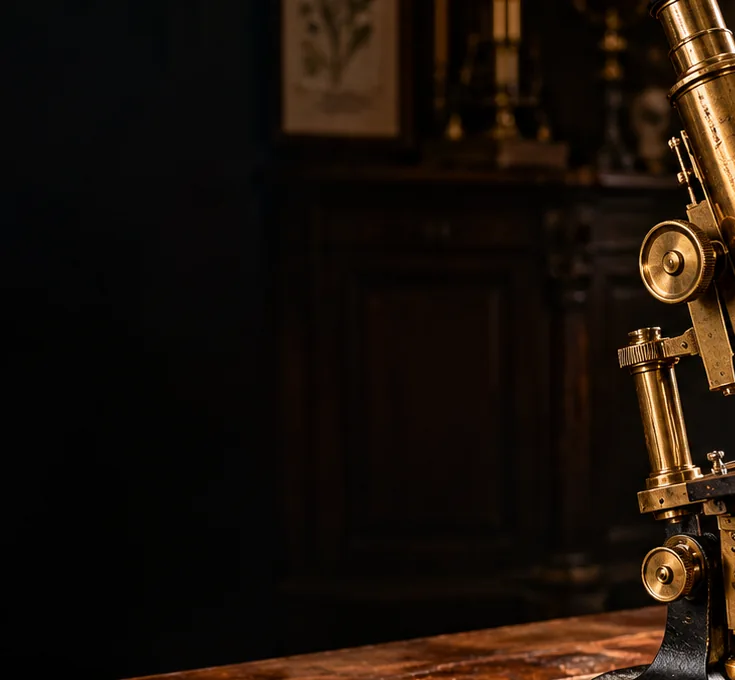
The Smith–Beck family of stands
Smith, Beck & Beck and R. & J. Beck appear in nineteenth-century documentation. The Science Museum describes substantial Beck research stands alongside more compact compound instruments.
Beck instruments range from imposing research stands to smaller teaching models. A dated Science Museum example provides a useful reference for proportions and serial-number placement.
How to recognize an original example
Begin with the engraved signature, stand construction, lens and eyepiece details, case fit, and any serial mark. Do not infer that every apparently period-correct part is original to the same instrument. If an objective or case has a different maker's name, document it rather than ignoring it.
What a collector should ask
- Can the seller photograph the exact engraved maker name and serial number?
- Do coarse and fine focus operate smoothly without force?
- Are the objectives, eyepieces, mirror and stage components included—and are they all shown?
- Does the original case have empty compartments?
- What is the packing and return policy for a fragile historical optical instrument?
Buying without romanticizing the listing
Vintage instrument listings often include optimistic dates and descriptions. Compare the actual photographs against documented examples. A complete, original, working microscope is not equivalent to a decorative restoration or a mixed set of accessories; both can be enjoyable, but they deserve different descriptions.
For more, read our collector valuation guide or use the inspection tool.