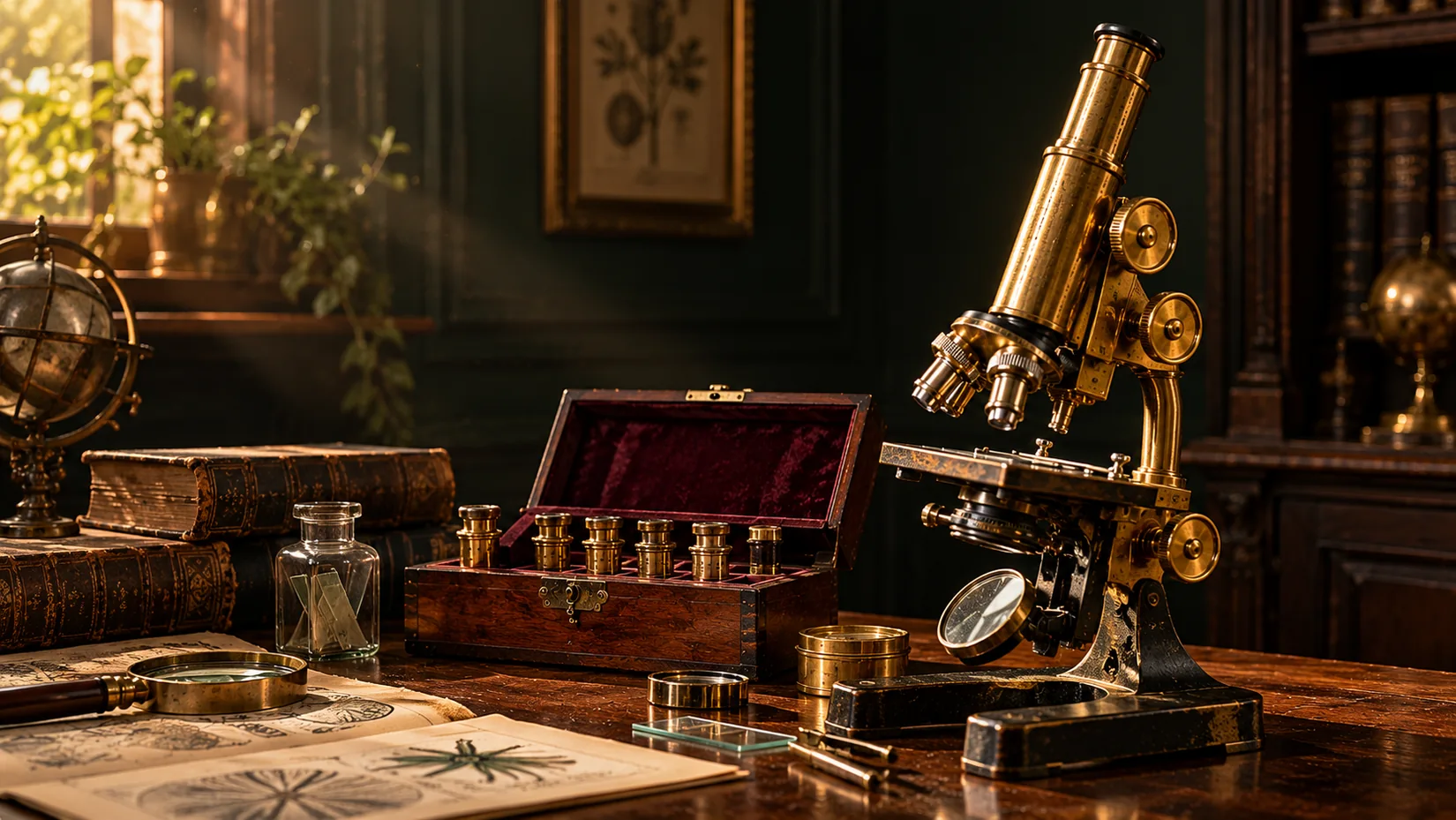
An empty cutout in a nineteenth-century wooden box can reveal more about missing accessories than a polished microscope ever will.
The case is a map of the original instrument
A fitted mahogany case may have custom slots for objectives, eyepieces, mirror parts, stage attachments and tools. A missing brass piece may be impossible to spot from a single photograph of the stand; an empty shaped recess makes the omission obvious. The Science Museum documents a large Henry Crouch microscope with its box and accessories, and other institutional object records describe cased Ross instruments.
Empty space is evidence, not a verdict
Cases can be swapped, refitted or modified over generations. The presence of unused recesses does not prove the instrument is incomplete as originally sold: accessories could have been ordered separately, storage furniture repurposed, and box layouts altered. Photograph every compartment before moving contents and compare the fitted shapes with known drawings or catalog descriptions when available.
The completeness premium needs proof
Collectors understandably like ‘complete with original case,’ but the phrase contains three separate claims. ‘Complete’ needs a checklist. ‘Original’ needs structural and documentary support. ‘Case’ only means there is a box. Avoid treating one antique-looking wooden chest as universal evidence of provenance. Ask whether keys, latches, divider blocks and matching maker plates survive.
Practical inspection routine
Request a clear overhead photograph of the open case with all contents arranged beside it, then a second photograph with the items nested. Check for compression marks on velvet, mismatched screw fittings and objectives that do not fit their slots. Estimate shipping based on the case’s protection and fragility, not simply on the instrument’s weight. An unsecured mirror or eyepiece can damage the instrument in transit.
A catalog that can be reconstructed
Record the case dimensions, compartment count, lining, markings and visible alterations in your collection ledger. Add a photo of each accessory, including objective barrel engravings. Over time, these notes become a way to identify related examples without assuming every surviving object is in its factory configuration.
The empty-tray audit
Lay out the case with the camera directly above it, without moving anything fragile. Record every fitted opening and its approximate dimensions. Mark openings as occupied, vacant or uncertain; a void could have held a useful objective, an eyepiece, a condenser attachment or a tool. Then photograph each loose part separately beside its storage location. This produces a reliable inventory even before you know what every fitting does.
On eBay, ask for the case to be photographed with the door fully open, not simply standing behind the instrument as a decorative prop. Look for internal damage, separated wooden dividers, detached velvet and broken latches. A repaired case can be authentic, and an apparently pristine case can be a later replacement. Aim for a documented configuration, not a categorical judgment from one visual feature.
| Case feature | Inspection question |
|---|---|
| Shaped recess | Does any surviving part fit it safely? |
| Maker plate | Is it on case, instrument, or both? |
| Lining | Wear consistent with storage, or recent refit? |
| Door and lock | Functional, damaged, or missing parts? |
Research exercise: document observations and cite the source behind each attribution. These are evidence prompts, not expert authentication.