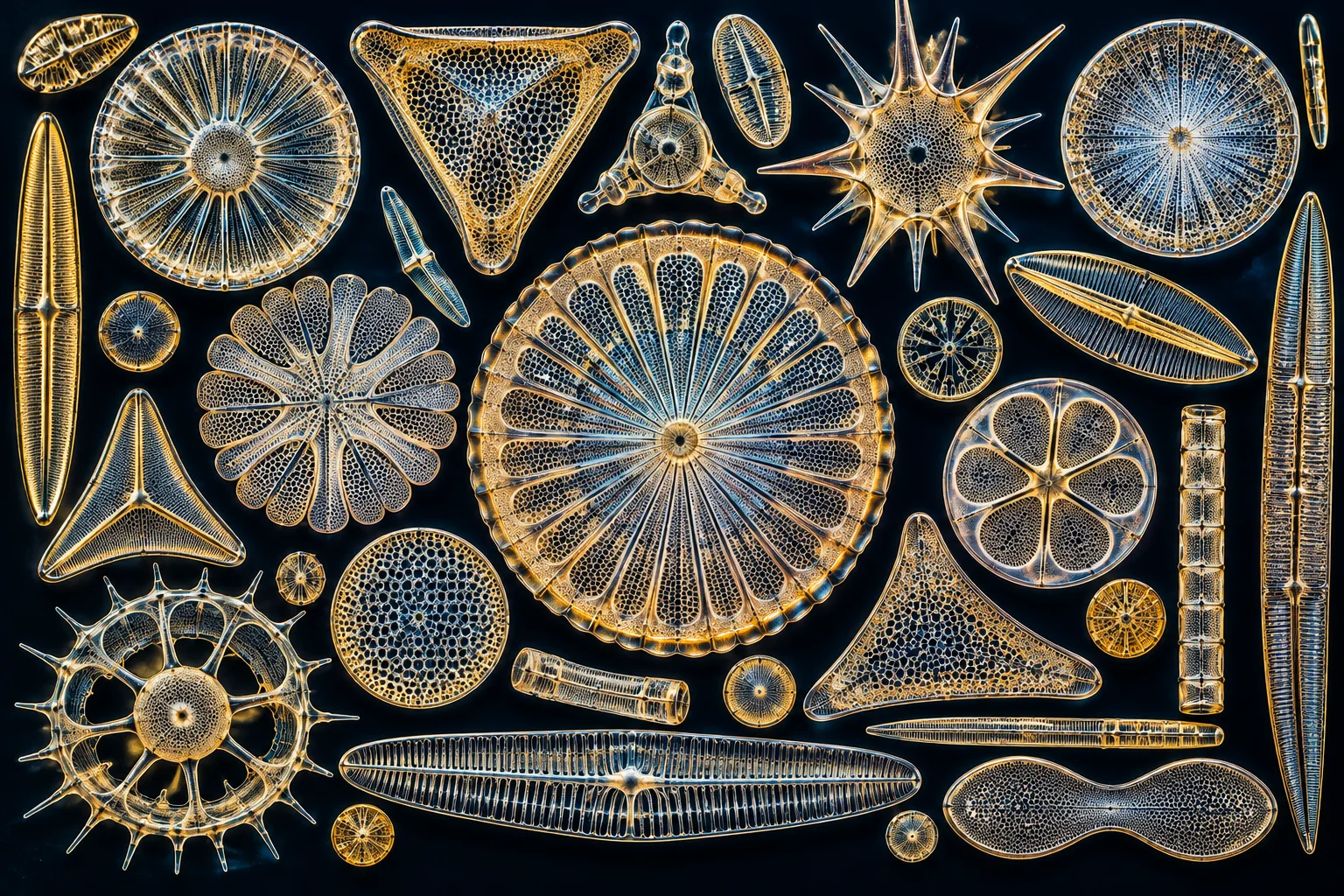
Tiny monuments, miniature portraits, diatoms arranged like jewelry: Victorian microscopy turned the invisible into an art form.
A cabinet, not just a glass rectangle
A surviving Victorian slide collection may contain botanical sections, insect parts, mineral samples and curious novelty preparations. To modern eyes they look like small pieces of glass; to their original owners they were libraries of specimens and evidence of a growing fascination with nature. The Whipple Museum documents one luxury cabinet containing commercial slides, home-mounted material, and microphotographs by John Benjamin Dancer. That breadth is a reminder that a slide’s story can be bigger than its specimen.
Diatoms: sculpture at the scale of dust
Diatoms are microscopic organisms with intricately patterned silica structures. Historical preparers sometimes selected and arranged them into decorative compositions. Collectors should distinguish a purposefully arranged slide from a routine mount and inspect the cover-glass seal, maker labels and any documentation. Our accompanying artwork is imagined, not an image captured from a specific antique slide. The physical object—not a dramatic online illustration—is what must be authenticated.
An address on a label can tell a story
Original labels may provide a maker’s name, an address, a preparation technique or a handwritten specimen identification. Do not turn a label into an instant date: an old printed stock label could be used later, an antique case might house replacement slides, and inscriptions can be copied. Photograph the front, reverse, slide edges and any mounting rings. Search museum databases for comparable label typography and trade records before making a confident attribution.
What makes a slide collectible?
Collectors may value documented makers, unusual subject matter, sophisticated mounts, provenance and sound condition. A spectacular-looking diatom slide with lifting cover glass or disturbed mount is not automatically the better acquisition. In listing photographs ask for an angled view showing the slide thickness, close-ups of the labels, and a transmitted-light image if the seller can provide one safely. Avoid asking sellers to open sealed historic mounts.
Buy the story, check the specimen
A box of ten slides can contain multiple generations of objects. Record each separately: subject, mount, label, observed damage, source and price. Cross-reference any maker claim with institutional examples, and keep the seller’s original photographs and written description. A well-documented modest specimen can provide more enduring satisfaction than an anonymous ‘museum quality’ novelty at an inflated price.
A three-photo test for a slide listing
Ask for a full top-down photograph with a ruler, a low-angle photograph showing the cover-glass and mounting ring, and a clear view of every label or handwritten note on the reverse. The first photo reveals the physical format; the second can disclose obvious lifting or damage; the third preserves inscription evidence that often disappears from sales summaries. If only a glowing microscope-view image is supplied, you may know almost nothing about the actual object being shipped.
Do not ask the seller to loosen or remove a historic cover slip for photography. The safest useful image is often one made without moving fragile parts. If the listing contains multiple slides, verify that each image corresponds to the particular slide described, and record any numbered cabinet slot that links the object to a larger set.
| Object | What to record |
|---|---|
| Label | Complete text, handwriting, color and location |
| Mount | Cover slip, ringing, obvious cracks and separation |
| Story | Seller claim, documented maker and confidence level |
| Comparable | Institutional object or dated catalog source |
Research exercise: document observations and cite the source behind each attribution. These are evidence prompts, not expert authentication.