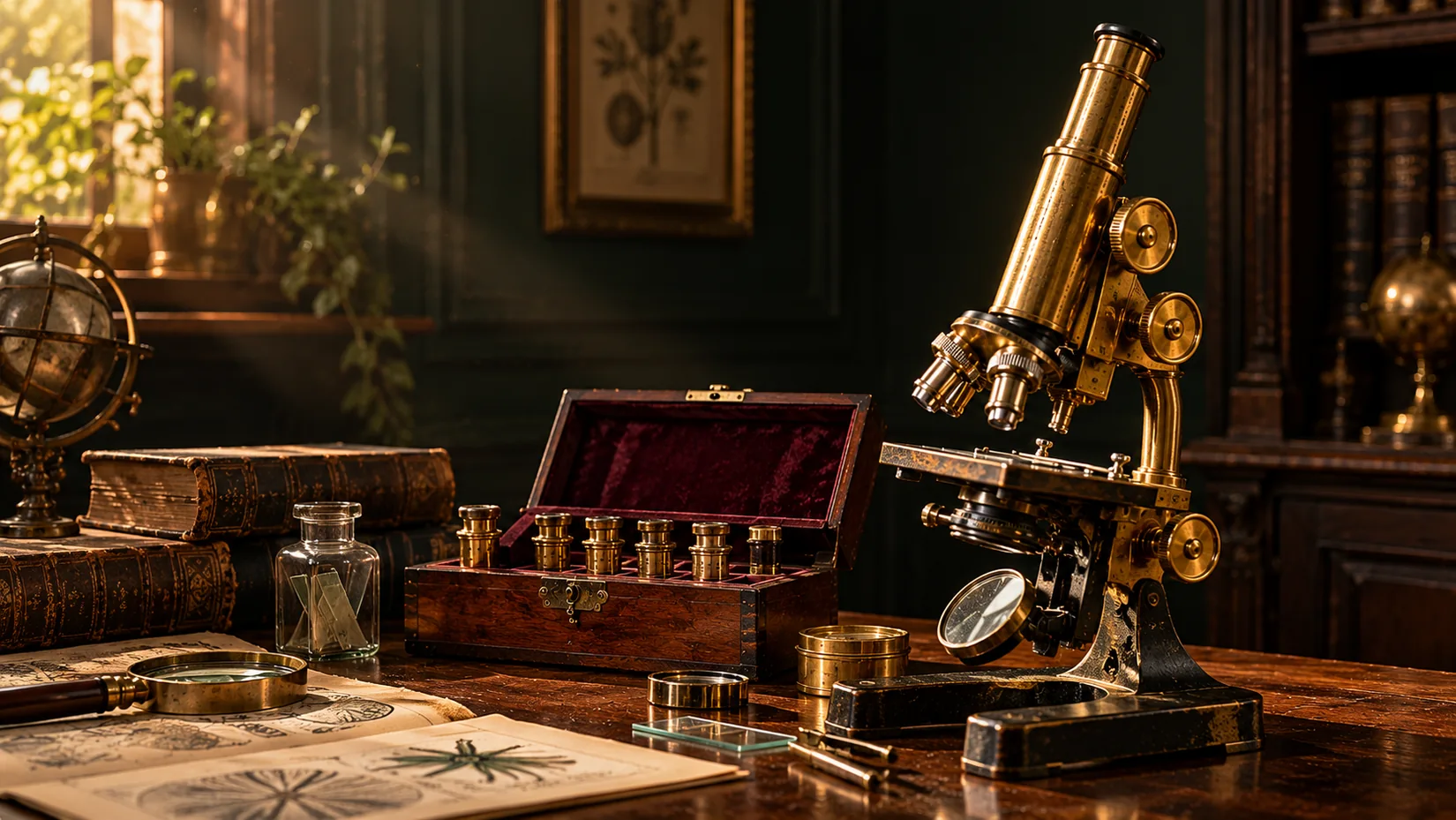
The satisfying answer is sometimes yes—but preservation and safe handling come before the urge to turn every brass knob.
Decide what you are preserving
A working historic microscope can be an educational pleasure, while an extremely fragile or rare instrument may be better preserved as an object. Begin with documentation: photograph the instrument and all accessories, inspect under stable light and note looseness, corrosion, broken glass or inappropriate lubricants. Do not treat functionality as the sole measure of historical value.
What is safe to assess without forcing parts
You can visually inventory the stand, tube, objective, stage and mirror and note whether controls appear aligned. If a mechanism resists, stop; many old mechanisms contain hardened lubricants or fragile joints. Use no domestic rust removers, penetrating oils or abrasive metal polish without qualified conservation advice. Original finish and patina can be part of the object’s evidence.
Lenses and the illusion of a clean exterior
A gleaming brass tube can conceal separation, chips or fungal growth in optical elements. Some old objectives and eyepieces are not readily interchangeable with modern accessories, and disassembly can make matters worse. If optics matter for your use, obtain a seller’s safe transmitted-light photograph and have an experienced specialist inspect the instrument before committing significant money.
What about old prepared slides?
Consider slides historical collections, not disposable test pieces. Their mounting media, edge seals and covers may be degraded; unknown specimens should not be disturbed. For a first functional demonstration, using modern commercially prepared slides and safe appropriate lighting can avoid unnecessary handling of fragile Victorian examples.
A better purchase question
Instead of asking only ‘does it work?’ ask ‘what has been tested, by whom, and how?’ Separate the seller’s visual inspection from an actual focusing test and from a professional conservation report. Keep an honest record of those distinctions in the collection ledger. Reliable uncertainty is better than an optimistic but undocumented ‘fully working.’
A conservation-first decision tree
If the stand is unstable, the optics are loose, the mirror is cracked or the motion controls bind, do not attempt a demonstration. Document the defect and seek someone experienced in historic optical instruments. If the instrument appears sound, decide whether a safe, supervised demonstration adds meaningful educational value. The historic finish, fitted case and mounted glass can remain the primary reasons to preserve the object even when it is not operated.
Avoid assumptions about illumination. Modern high-intensity lighting, direct sunlight, unsuitable heat sources and improvised adapters can introduce new risks. Historical instruments were designed for particular illumination and optical configurations. A gentle visual assessment is not a diagnosis of operating safety; a specialist assessment may be justified for delicate or valuable pieces.
| Observation | Conservative response |
|---|---|
| Stiff focus | Stop; do not force or lubricate casually |
| Loose optics | Keep supported; seek advice |
| Old mounted slides | Preserve untouched; use expendable modern material for tests |
| Unknown restoration | Document before any intervention |
Research exercise: document observations and cite the source behind each attribution. These are evidence prompts, not expert authentication.