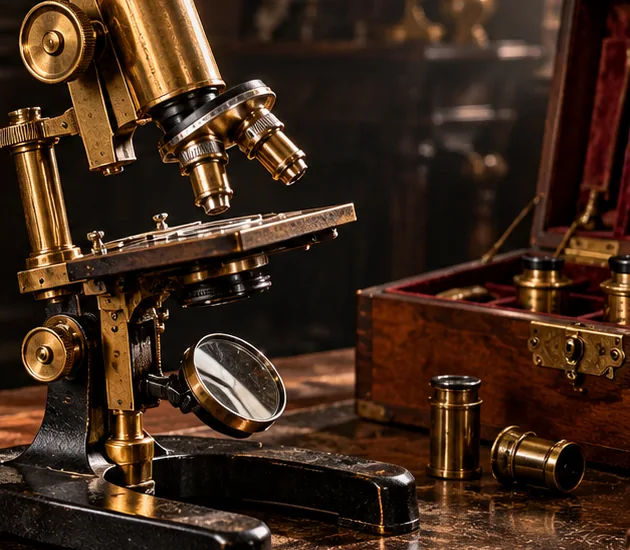
Antique Zeiss and Leitz microscopes require careful identification of the stand, optics, labels, and case, not just the name on one lens.
First identify the maker of the stand
A brass objective stamped “Carl Zeiss Jena” does not prove every mechanical part was made by Zeiss. Historic microscopes often acquired replacement objectives and eyepieces during their working lives. Study the body, foot and stand engraving separately from optics. If the seller only photographs the objective, ask for the maker plate on the stand and a full view of its shape.
Date by a documented model, not a bare serial number
A number can be useful if it belongs to a reliable maker- and product-specific sequence. But internet charts may mix optical components, later corporate products and instruments. Compare the stand and its controls with a dated catalog or museum record; preserve uncertainty when no precise match exists.
A collector’s comparison
Do a side-by-side inspection of the focusing mechanisms, stage, condenser, drawtube, mirror, and case. Compare instruments of similar age and function. An early student microscope and an elaborate research stand should not be ranked as if they were equivalent products.
What to ask before buying
Request photographs of each optical barrel inscription, the stand signature, focus controls and all components laid out beside the case. Ask whether the objective produces an image, but never encourage testing with force. Check the buyer’s return options, shipping arrangements and total landed cost.
Use three sources of evidence
Separate the seller’s description, contemporary museum or catalog documentation, and your own physical observations. A match in style is a clue, not authentication. Spend as much time examining what is missing as what looks attractive.
Use our visual anatomy workshop, seller photo checklist, auction cost calculator, and archival comparators while assessing a candidate.
Compare like with like
Put three candidate listings into a comparison sheet and record the same fields for each: maker on the stand, maker on the objectives, identifiable model, documented approximate period, case and its compartments, mechanical issues, optics test, shipping and return terms. When comparing the two German makers, avoid generic claims that one always brings a premium. A standard laboratory Leitz and a specialized Zeiss research stand are different categories. The strongest purchase is usually the best-documented example that satisfies your collecting objective, not the most ambitious seller title.
Separating display quality from optical usefulness
For a study or display collector, a consistent finish and correct case fittings may be more important than the microscope's ability to accept modern slides. For someone who intends to use the instrument, objective condition, focus smoothness, illumination and the availability of replacement consumables matter more. Ask which of these goals the seller's description actually addresses. A listing claiming 'works' because the brass focus turns is not the same as proof that the optics resolve a specimen. Likewise, a beautiful Zeiss-branded eyepiece mounted on a later stand should not be marketed as a complete early Zeiss outfit.
A four-photo authentication sequence
Start with a full side view that shows the stand's limb, stage and base. Add an overhead view of the stage; a close-up of the maker inscription and serial; and separate views of every objective and eyepiece. An engraving on the body tube can be compared with contemporary catalog images, but remember that the body and base may have been assembled from different surviving instruments. Ask whether any parts have been repaired, re-lacquered or replaced. A seller who cannot provide these views may still be honest, but you will be accepting extra uncertainty, and the price should reflect it.